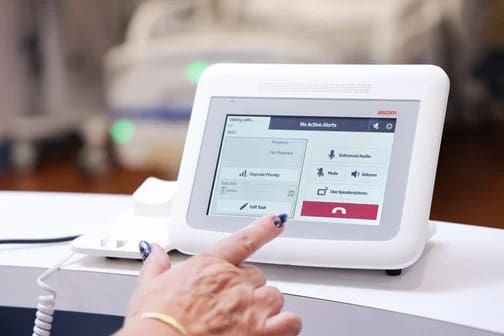
Healthcare environments are under constant pressure to do more with less. Staffing shortages, rising patient expectations, and increasingly complex care environments have forced providers to rethink how communication happens across their facilities. What was once a simple “call button” has evolved into something much more powerful.
Modern nurse call systems are now a critical layer of clinical infrastructure. They connect patients, caregivers, devices, and workflows in real time, helping teams respond faster and work more efficiently. A recent blog from Ascom highlights just how far this technology has come, offering a behind-the-scenes look at how smart nurse call systems operate from the patient room to the nursing station.
If you are evaluating your current system or exploring what is possible, it is worth taking a deeper look:
Beyond the Call Button: A Connected Care Environment
One of the biggest takeaways from the Ascom blog is that nurse call is no longer a standalone system. It is part of a broader communication network that links devices, staff consoles, mobile phones, and alerts across an entire facility.
Instead of relying on rigid, point-to-point connections, modern systems are designed to scale. That means hospitals and senior care communities can adapt workflows, add rooms, or integrate new technologies without rebuilding their infrastructure. The result is a more flexible environment where communication flows seamlessly, and care teams can respond without delay.
At the center of this ecosystem is the ability to route alerts intelligently. Calls are not just sent; they are prioritized, escalated, and directed to the right caregiver based on availability and urgency. This reduces noise, eliminates confusion, and helps staff focus on what matters most.
Improving Response Times and Staff Efficiency
Speed matters in healthcare. Whether it is a routine patient request or an emergency, response time can directly impact outcomes.
Smart nurse call systems improve this by combining visual cues, mobile alerts, and centralized coordination. For example, corridor and dome lights provide instant, at-a-glance information about patient needs, while staff consoles act as a command center for managing and routing tasks.
This level of visibility allows care teams to act quickly and confidently. Instead of searching for information or relying on verbal communication, staff can see exactly where they need to go and what is required of them.
At the same time, mobile integration ensures that caregivers are not tied to a single location. Alerts can be delivered directly to mobile devices, allowing staff to respond while staying productive throughout their shift.
Where B&B Integrations Fits In
Technology alone is only part of the equation. The success of a nurse call system depends on how well it is implemented, integrated, and supported over time.
That is where B&B Integrations comes in.
As a strategic partner with Ascom, B&B Integrations delivers complete, integrated communication solutions tailored to healthcare environments. Our approach goes beyond installation. We work closely with facilities to design systems that align with real-world workflows, ensuring that nurse call, mobile communication, and alert systems operate as a unified platform.
This integrated approach helps improve patient safety while also reducing stress on caregivers. When alerts are routed correctly and information is accessible in real time, staff can prioritize tasks, coordinate responses, and maintain focus throughout their day.
B&B also emphasizes training and ongoing support, which is critical in healthcare settings where systems must evolve. As workflows change, the system can be adjusted without disrupting operations, helping facilities stay efficient long after implementation.
Turning Technology Into Better Outcomes
The real value of a smart nurse call system is not just in the technology itself. It is in the outcomes it enables.
When communication is streamlined, caregivers can spend less time managing alerts and more time with patients. When systems are integrated, data can be used to improve workflows and identify opportunities for better care. And when infrastructure is built to scale, facilities can adapt without starting from scratch.
These are the kinds of improvements that healthcare leaders are looking for today.
If you want a deeper understanding of how these systems work and why design decisions matter, the Ascom blog provides a detailed walkthrough worth exploring:
Learn More About B&B Integrations
If your organization is evaluating nurse call systems or looking to modernize communication workflows, B&B Integrations can help you take the next step. Our experience with Ascom solutions and integrated healthcare systems positions them to design a solution that fits your environment, your staff, and your long-term goals.

Leave a Reply